Living Legend No. 64 – Dr. Robert J. Chandler
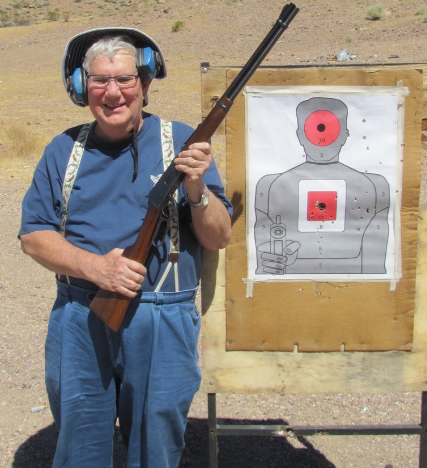
Westerners International Living Legend No. 64 Dr. Robert J. Chandler
Dr. Robert J. Chandler (1942-2019), an Army brat, was born in Utah. Much of his childhood was spent in Hawaii, many of his student years in Southern California, and he spent most of his adult life in Northern California. Bob joined the San Francisco Corral of Westerners in 1987. Thirty years later, in 2017, during a moment of weakness, he allowed himself to be persuaded by Brian D. Dillon to also join the Los Angeles Corral.
Chandler was repeatedly the Sheriff of the San Francisco Corral, having served in that capacity in 1992, 2002, and finally from 2016 through 2017. He made over a half-dozen presentations to the San Francisco Corral and in 2016 also graced the Los Angeles Corral with his benign presence as a scholarly presenter. Bob contributed articles to the Los Angeles Corral’s Branding Iron, and his books were favorable reviewed within its pages. Chandler had the unique honor of seeing his penultimate literary opus get published quite literally on the day he died as the lead article of Branding Iron No. 293. What may very well be Bob’s final publication was his chapter in Aloha, Amigos! the Los Angeles Corral Brand Book 24, published posthumously in 2020.
Dr. Chandler was an historian of international repute, specializing in California history, political history, economic, monetary and banking history, historical ephemera, printing and lithography, and the history of California racial, ethnic, and cultural minorities. Bob earned his Ph.D. in history in 1978 at U.C. Riverside: his dissertation was The Press and Civil Liberties in California During the Civil War. He then spent 32 years as Senior Research Historian for Wells Fargo Bank, based in San Francisco. Bob wrote more than 60 articles on California during the Gold Rush and Civil War periods on civil rights, commerce, finance, gold, journalism, politics, military suppression, numismatics, philately, printing, stagecoaching, steamships, and Wells Fargo generally. He served as an editorial advisor to the California Territorial Quarterly until that outstanding journal became a casualty of the catastrophic Camp Fire in 2018, and was one of that journal’s most consistent contributors for more than twenty years.
Bob was the co-editor (with Bob Schoeppner) of the very first two Brand Books published by the San Francisco Corral (BB 1: 1996; BB 2: 2001). He was also the recipient of three prestigious Westerners International Coke Wood Awards, the first (for 2001) for California Stagecoaching: The Dusty Reality (Dogtown Territorial Quarterly 47, Fall, 2001: 4-24, 34-40); the second (for 2005) for his co-authored article with Steve Potash The Pacific Mail: Pioneering U.S. Flag Steamship Company (The Argonaut, 16, Summer, 2005: 54-106), and the third (for 2010) for his three articles on the Pony Express (California Territorial Quarterly, 81, Spring 2010: 4-27; 28-41; 42-49). Chandler’s books include an Illustrated History of California (2004); Arcadia’s Wells Fargo (2006); Gold, Silk, Pioneers & Mail: The Story of the Pacific Mail Steamship Company (co-authored with Stephen J. Potash, 2007); and San Francisco Lithographer: African American Artist Grafton Tyler Brown (University of Oklahoma Press, 2014). Bob’s final book, An E Clampus Vitus Hoax Gone Awry: Sir Francis Drake’s 1579 Plate of Brasse was published by the Grand Council of the ECV in 2018.
In addition to being one of the most active of all Westerners, Dr. Chandler was a member of the bibliophilic Roxburghe Club of San Francisco, and also served on the Council of the Friends of the Bancroft Library at the University of California, Berkeley. He was the Director of the San Ramon Valley Museum and the past President (2003-2011) of the Western Cover [Philatelic] Society and also its secretary. He was the President (2005-2007) of the Book Club of California, and was the long-time (1996-2013) editor of its Quarterly News-Letter. Bob was the President (1981-82) of the San Francisco Civil War Round Table, he was an honorary Kentucky Colonel and the past President of the Fighting ‘49ers Toastmasters (1980, 1982, 1984, 1992).
Bob “Clamper” Chandler was the living embodiment of his alter-ego, Norton I, Emperor of the United States and Protector of Mexico. He was the X-Noble Grand Humbug of Yerba Buena #1, the Mother Lodge, of E Clampus Vitus, holding this exalted position in 2005-2006. During his few remaining minutes of spare time stolen from his research, writing, publishing, and public speaking Bob was also a devoted husband to his long-suffering wife Susan and a loving father to his three adult children, all of whom willingly served out life sentences as his closest relatives without any possibility of parole.
In recognition of Dr. Robert Chandler’s exemplary service to Westerners International, to the advancement of California History, and of his many contributions to Western Civilization, especially his valiant efforts in stemming the rising tide of illiteracy on the Pacific Littoral, he was made a Living Legend of both the San Francisco and Los Angeles Corrals, Westerners International, in 2018.
By Brian Dervin Dillon, Ph.D., 2018; revised 2022
Roundup: November 9 2022
november2022
Roundup Synopsis
Taken From Branding Iron 308 Fall 2022.
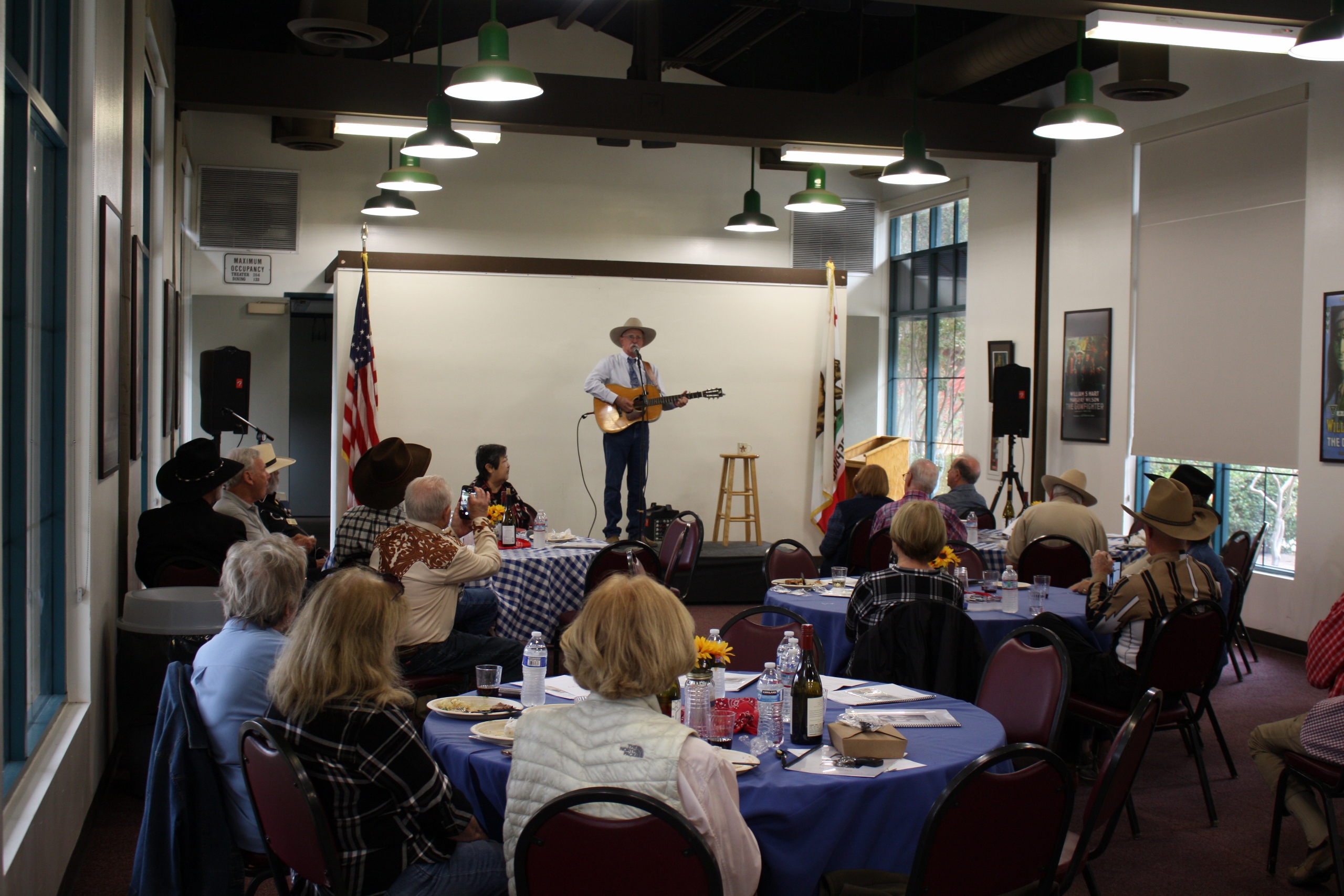
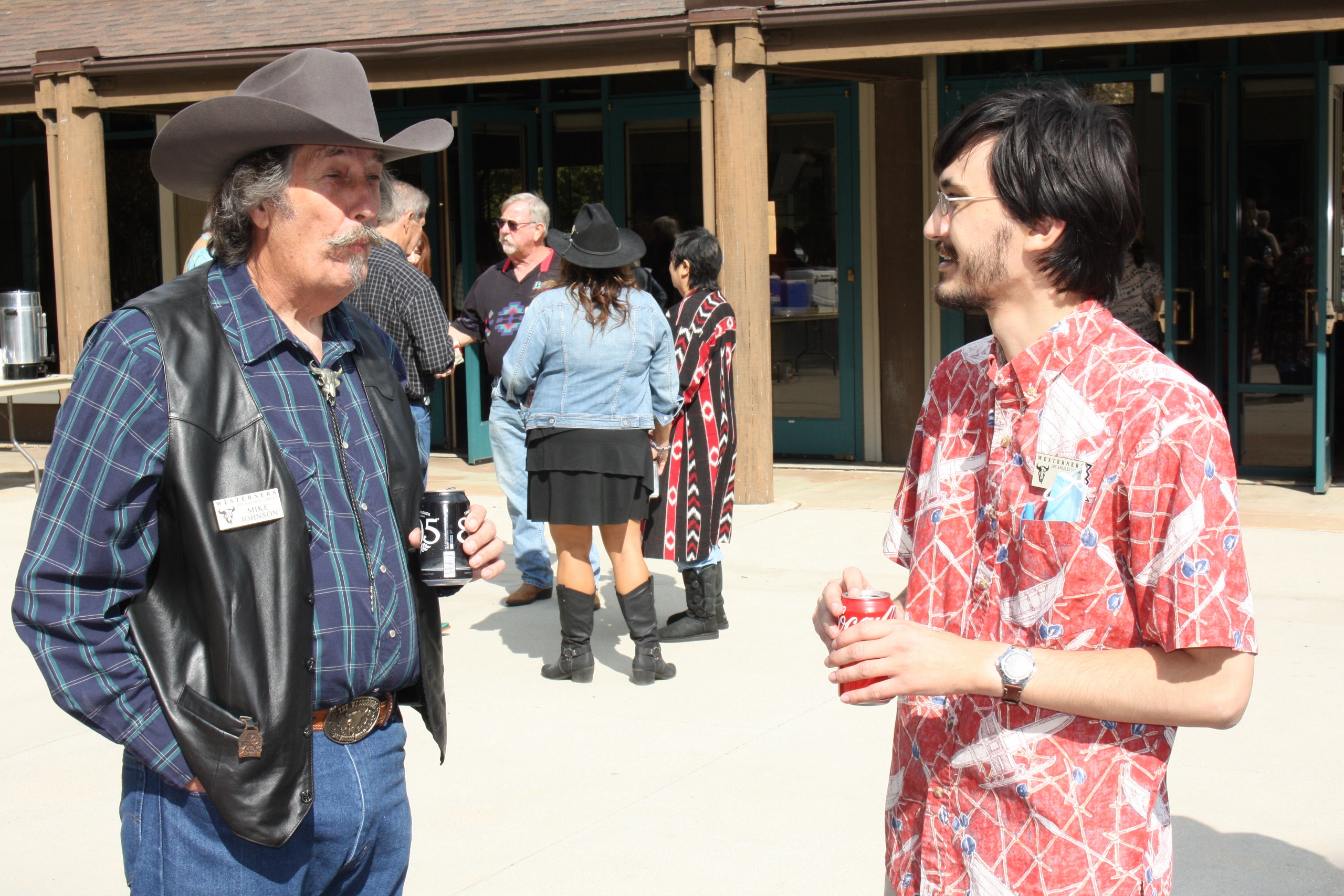
Michael Johnson didn’t have a clever hat when he showed up at the Roundup in November. Thankfully for us, though, he did have a clever head under his usual cowboy hat. Mike used that clever head to edify those of us in attendance on the subject of the Overland Mail Company. The company was, as its name implied, a mail route which ran over land, particularly the southwestern parts of our land from 1858 to 1861, carrying mail between San Francisco in the West and both St. Louis and Memphis in the East.
The Overland Mail Company was founded by John Warren Butterfield (1801- 1869) and, as such, is sometimes referred to as the Butterfield Overland Mail. The company’s founding was the result of Butterfield winning a bid for a contract offered by the federal government to carry mail to the West. John Butterfield had a background in transportation. Having cut his teeth driving coaches in New York, he progressed to ownership of forty coach lines in Utica, as well as successful ventures into steamboats on lake Erie and trains on the rails of western New York. In 1850 John’s stagecoach interests, under the Butterfield Wesson Company, were merged with the express companies of Wells & Co., and Livingston, Fargo & Co., to create The American Express Company. However, it was Butterfield, under his own name, who won the contract for the route to be run by what became the Overland Mail Company.
The route chosen by Butterfield was the longest overland mail route in the world, and was sometimes known as the Oxbow Route because of the way it curved through the southwestern territories, recently claimed by the U.S. from Mexico. The route, though long, had the advantage of being free of snow, which perhaps gave it an advantage over the Central Route which made its way across the prairie towards Utah.
Although Butterfield adamantly stated, in the rulebook he published for his employees, that no cash was to be carried by the company along the route, one story—a set of rumors shrouded by the veil of time—persists. The consistent threads of its narrative are two men, the sum of $60,000, and the settings of the Vallecito and Carrizo stations. One story has $60,000 being taken in gold, by two men, from a coach at the Carrizo station, then sees the two robbers shooting it out at the Vallecito station. Another tells a tale of two brothers arguing and killing each other at the Vallecito station. A third has a driver leaving Yuma with a $60,000 payload and no shotgun rider. Indians, after waylaying the solo driver, purportedly buried the coach near the Carrizo station, being interested only in the horses. Though, as Mike pointed out, it’s a bit hard to imagine the thieves going to the trouble of burying the stagecoach when they could much more easily have burned or left it. Was the Butterfield stage robbed? It’s unlikely we’ll ever know, but it’s not a bad bet.
All good things come to an end, however, and the wild days of the southern stage coach are no exception. The secession of the South and the outbreak of the Civil War saw operations along the Oxbow Route halted, its four-year flash-in-the-pan burnt out. After the war, the new railroad superseded the overland routes, and closed a significant chapter in the history of the West.
— Alan Griffin
Photos from the Roundup
To be posted soon!
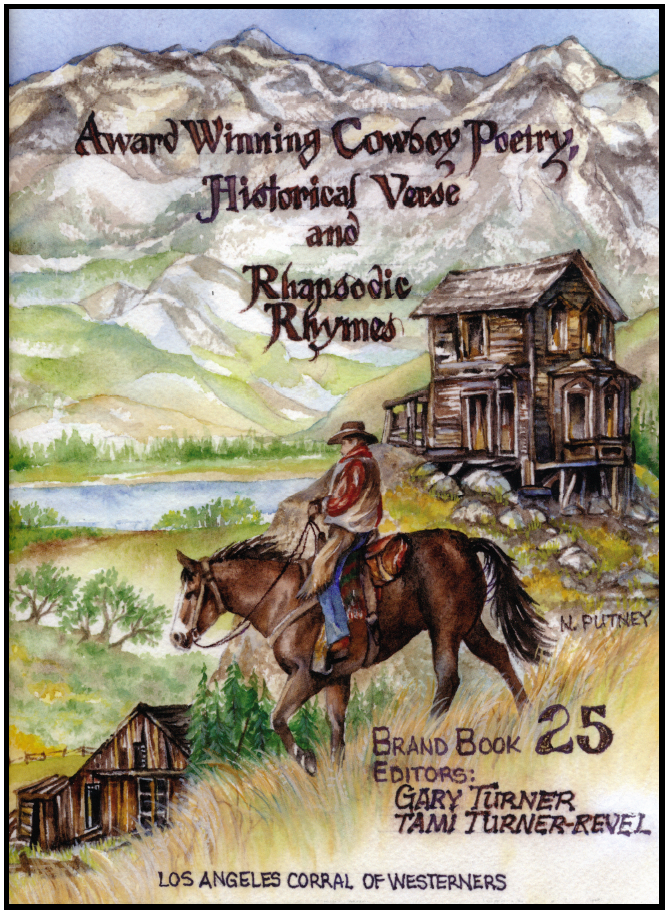
The Westerners Brand Book #25 (2022)
Award Winning Cowboy Poetry, Historical Verse, and Rhapsodic Rhymes
Gary Turner and Tami Turner-Revel, Editors
Synopsis
Los Angeles Corral Brand Book 25, Award Winning Cowboy Poetry, Historical Verse, and Rhapsodic Rhymes has just been published. It is the first full-length book of poetry ever published by any of the 70+ Westerners Corrals around the world, and is beautifully illustrated with original artwork by renowned western artist Nancy Putney. Brand Book 25 reprises poems that won the Fred Olds Cowboy Poetry Award from Westerners International between 2007 and 2019, as well as brand-new offerings published for the very first time. Contributors include Bill Bender, Joseph Cavallo, Barbara J. Goldeen, Tim Heflin, Abraham Hoffman, Eric Nelson, Pablo/Paul McClure, Kenneth Pauley, Jan Porter, Paul Rippens, Jerry Selmer, Paul & Nolene Showalter, Froylán Tiscareño, Daryl Turner, Gary Turner, and Loren Wendt. Gary Turner and Tami Turner-Revel, editors; hardbound, illustrated, 368 pages, 2022.
The Westerners Brand Book #24 (2020)
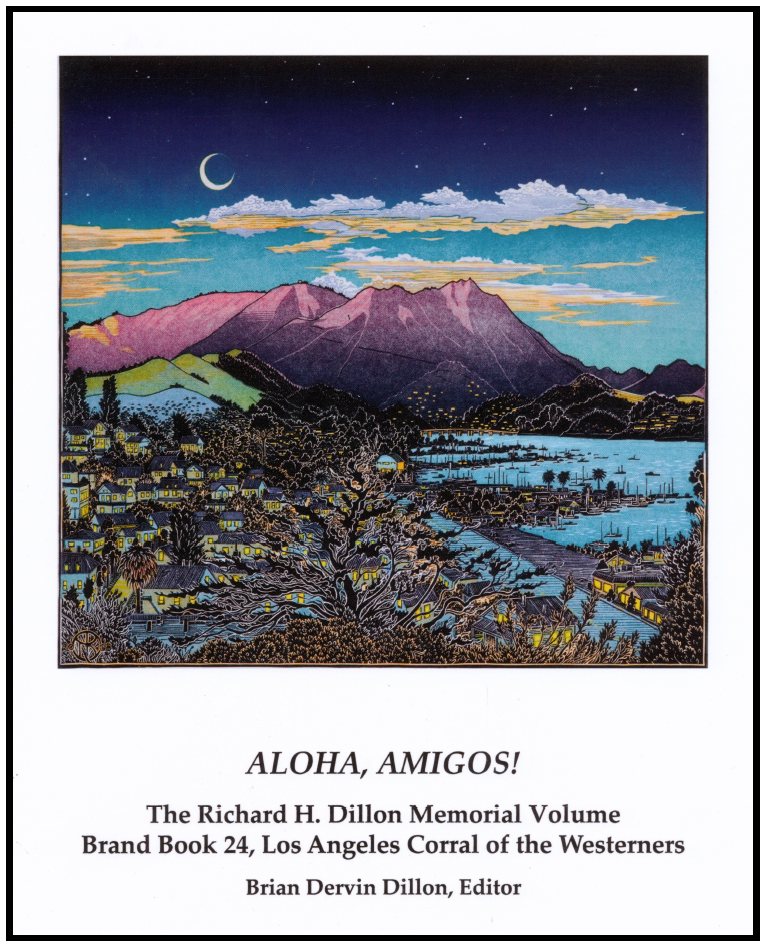
Aloha Amigos!
Brian Dervin Dillon, Editor
Synopsis
Los Angeles Corral Brand Book 24, Aloha, Amigos! Is the Richard H. Dillon Memorial Volume. Dick Dillon (1924-2016) was a world-famous western historian, librarian, teacher, and public speaker. He was the single most productive historical writer on California and the American West, who published dozens of full-length books, hundreds of scholarly journal and popular magazine articles, and thousands of book reviews over a longer period of time (82 years) than any other writer. Richard H. Dillon was a long-time member of both the Los Angeles and the San Francisco Corrals of Westerners International, and was made a W.I. Living Legend in 2003.
Aloha Amigos! Won the Westerner’s International Best Book Award in 2021. It features the first ever biography of Richard H. Dillon, culture-historical studies and paeans by his friends, colleagues, and admirers, and the first comprehensive bibliography of his published works. Contributors from four different Westerners International corrals include Will Bagley, Peter Blodgett, John Boessenecker, Matthew Boxt, Phil Brigandi, Robert Chandler, David Dary, James Delgado, Brian D. Dillon, Lynn Downey, Abraham Hoffman, Tommy Killion, Gary Kurutz, Valerie Sherer Mathes, James Shuttleworth, Kevin Starr, and Francis J. Weber. Brian Dervin Dillon, editor; hardbound, illustrated, 588 pages, 2020. To order: please use the multi-volume order form following this notice.
Contents
-
- Foreword — Kevin Starr
I: Biographical
-
- Duke Lopez in Sausalito (1924-1943) — Brian Dervin Dillon
- The Perfesser with his Uncle Samuel (1943-1946) — Brian Dervin Dillon
- Sutro Dick, the Kid in the Candy Store (1946-1959) — Brian Dervin Dillon
- Dick Dillon, the Literary Alchemist (1959-1979) — Brian Dervin Dillon
- Aloha, Amigos! the Latest Word from RHD (1979-2016) — Brian Dervin Dillon
- RHD Biographical Notes, Bibliography, Appendices — Brian Dervin Dillon
II: Culture-Historical Contributions
-
- Late Prehistory at La Venta, Tabasco, Mexico — Matthew A. Boxt
- California’s Twelve “Apostles” — Francis J. Weber
- Later Travel on the Southern Emigrant Trail — Phil Brigandi
- Black Rights and Squelched Secessionists in California — Robert J. Chandler
- San Francisco’s Old Ship Saloon — James P. Delgado
- Helen Hillyer Brown, the Comstock and Beyond — Lynn Downey
- The Pacific Mail Steamship Line — James Shuttleworth
- The Women’s National Indian Association in Northern California — Valerie Sherer Mathes
III: Paeans
-
- Historian, Librarian, and Biblio-Friend — Gary Turner and Tami Turner-Revel
- Postcards from Dick Dillon — David Dary
- Dillonography — John Boessenecker
- Richard H. Dillon, Book Reviewer — Abraham Hoffman
- Richard H. Dillon as Documentary Editor — Peter J. Blodgett
- Historian’s Historian — Will Bagley
IV: Dick Dillon’s Literary Legacy
-
- Richard H. Dillon’s Published Works — Brian Dervin Dillon
V: About the ContributorsVI: The Los Angeles Corral







Los Angeles Corral of Westerners
Welcome to the online home of the Los Angeles Corral of Westerners. We invite you to browse our site, learn more about our organization, and even consider joining us.