Living Legend No. 66 – Bob Clark
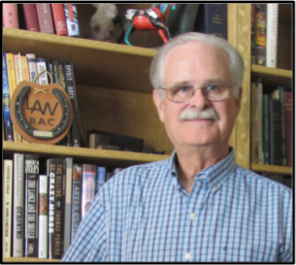
Westerners International Living Legend No. 66 Bob Clark
Robert A. Clark, distinguished third-generation bookman, publisher, and historian, has had the longest connection with the Los Angeles Corral of Westerners International of any living member, from his own infancy. Paul Galleher, co-owner of the Arthur H. Clark Company, was one of the original 1946 founders of the Los Angeles Corral of the Westerners. Galleher served as the Corral’s second Sheriff in 1948, the same year that Robert A. Clark was born in Pasadena. Bob’s father Art Clark soon joined the Los Angeles Corral, and became very active within it. While Harry Truman was in the White House a very young Bob Clark not only cruised the lanes between the stacks of his family’s bookstore on all fours but also later “attended” some of the earliest L.A. Corral Trail Boss meetings as a silent, grade-school-aged observer. His attendance was facilitated during the late 1940s and early 1950s because the L.A. Westerners meetings were held at the A.H. Clark offices/bookstore. In 1953, Bob’s father Art Clark became the Los Angeles Corral’s lucky 7th Sheriff. Bob Clark reminisces about how the L.A. Corral provided an informal education during the Eisenhower years: “Augie Schatra and Don Meadows would complain and holler, but Ray Billington calmed the waters…I watched in awe, and learned about how board meetings worked from these guys.”
Bob’s formal education was at Humboldt State University, where he earned a degree in history, then joined the family publishing business full-time. The Arthur H. Clark Company, founded by Bob’s grandfather in 1902, has an outstanding record of publication in Western American history that is second to none. Robert A. Clark followed in his father’s and grandfather’s footsteps as Editor in Chief (1984) of this very productive and well-respected publishing company and then as CEO (1989) as it moved and expanded from Glendale, California, to Spokane, Washington, and finally to Norman, Oklahoma.
Robert A. Clark began attending the Los Angeles Corral of the Westerners meetings once again, now as an adult, alongside his father. He became a member in his own right in the 1970s. Bob served as the head of the Los Angeles Corral in 1988, following in his father’s footsteps as its first-ever second-generation Sheriff. Bob’s interests and geographical peregrinations led him to join three other Westerners Corrals: Huntington (California), Spokane (Washington), and Cross Timbers (Oklahoma). In doing so he may be unique amongst all Westerners around the world, since his memberships in far-flung corrals are separated almost exactly by 1200+ miles North-South and the same distance East-West. Bob’s long-term commitment to Westerners International was recognized by his election to the WI Board, where he served as President (the Sheriff of all Sheriffs), for the years 2000-2002.
Bob Clark was no less active in the Western History Association. He joined this organization in 1974,attended its conference meetings annually and served in various capacities. He also served on the board of trustees for the Washington State Historical Society from 1990 to 1999, and was vice-president of the board from between 2000 and 2006. Robert A. Clark has also been active in the Oregon-California Trails Association, the Lewis and Clark Trail Heritage Association, and the Mormon History Association.
Simultaneously with his service to Westerners International and other historical organizations, while still at the tiller of the most respected scholarly press specializing in Western American history bearing his family name, Bob Clark’s output reached its zenith: he was personally responsible for publishing 400+ works on the American West through the A.H. Clark company and the University of Oklahoma Press. He also somehow found the time to serve as production editor and designer for no fewer than five different scholarly journals on Western American history: the Southern California Quarterly,California History (the California Historical Society Quarterly), Overland Journal (the California-Oregon Trails Association Quarterly), the California Mission Studies Quarterly Boletín, and We Proceeded On (the Lewis and Clark Trail Heritage Association Quarterly).
Rounding out Bob’s 16-hour workdays, week after week, year after year, he continued the family’s antiquarian book-selling business as part of the A.H. Clark Company’s fully-rounded commitment to Western American history. Not only the publisher of works by other leading scholars, including Westerners from many different corrals, Bob has also contributed in his own “write” as well, as the author, co-author, and editor of three books, and several dozen book introductions and articles on Western American history.
After more than eight decades in Glendale, California, Bob moved the Arthur H. Clark Company to Spokane, Washington, in 1989. Then, in 2006, Bob moved both himself and his wife Sheila along with the A.H. Clark Company to Norman, Oklahoma. There it functioned as an imprint of the University of Oklahoma Press under his direction. In 2012 Bob and Sheila moved back west to “Baja British Columbia” where he was honored to serve as the Editor-in-Chief of Washington State University Press. The veteran of more years in scholarly publishing than any other three or four hard-working bibliophiles, Bob finally retired in 2019. He is now most easily reached by cell phone on the Pullman, Washington, golf course, except during inclement weather.
Few historian-publishers have had a closer and more formative relationship with the Frontier West than Robert A. Clark. For more than half a century just about every member of all 70+ Westerners Corrals around the world have enthused about books published by him. These find places of honor on bookshelves in both public and private libraries alongside earlier volumes published by Bob’s father and grandfather. Western historians for more than a century have thanked their lucky stars that three generations of Clarks, and the wonderful Arthur H. Clark Company, have so diligently and outstandingly filled their literary needs for so long.
The Los Angeles Corral is pleased and proud to announce that the Home Ranch of Westerners International has accepted Robert A. Clark as Living Legend No. 66, an honor as well-deserved as it is overdue
Nominated by Brian Dervin Dillon, Ph.D., 8 17 2019
Members’ Store
Fandango Store
Click here for the Fandango Store, where you can purchase your registration online!
Rendezvous Store
Click here for the Rendezvous Store, where you can purchase your registration online!
Roundup Store
Click here for the Roundup Store, where you can purchase your registration online!
Annual Dues Store
Click here for the Dues Store, where you can pay online!
Roundup: December 2021
Roundup Synopsis
Taken from the Winter 2021 Branding Iron.
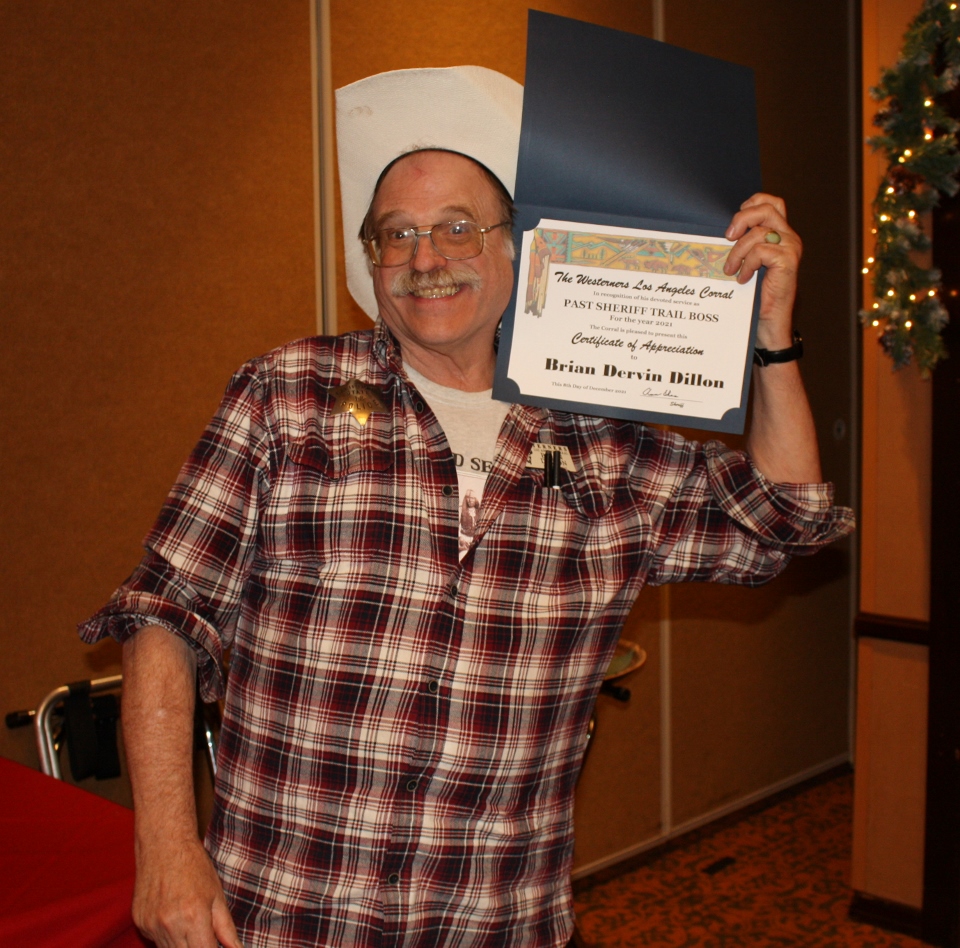
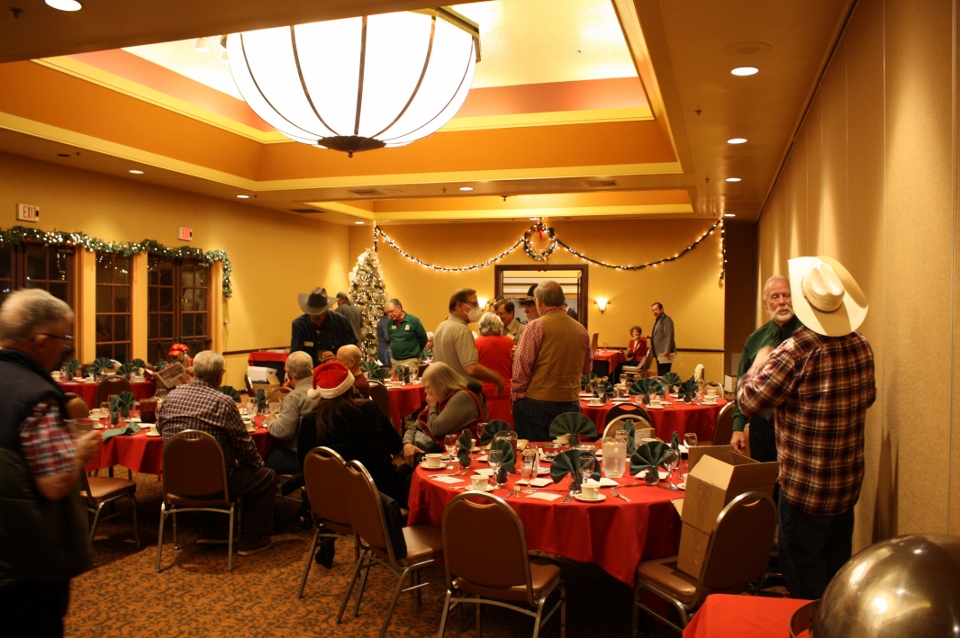
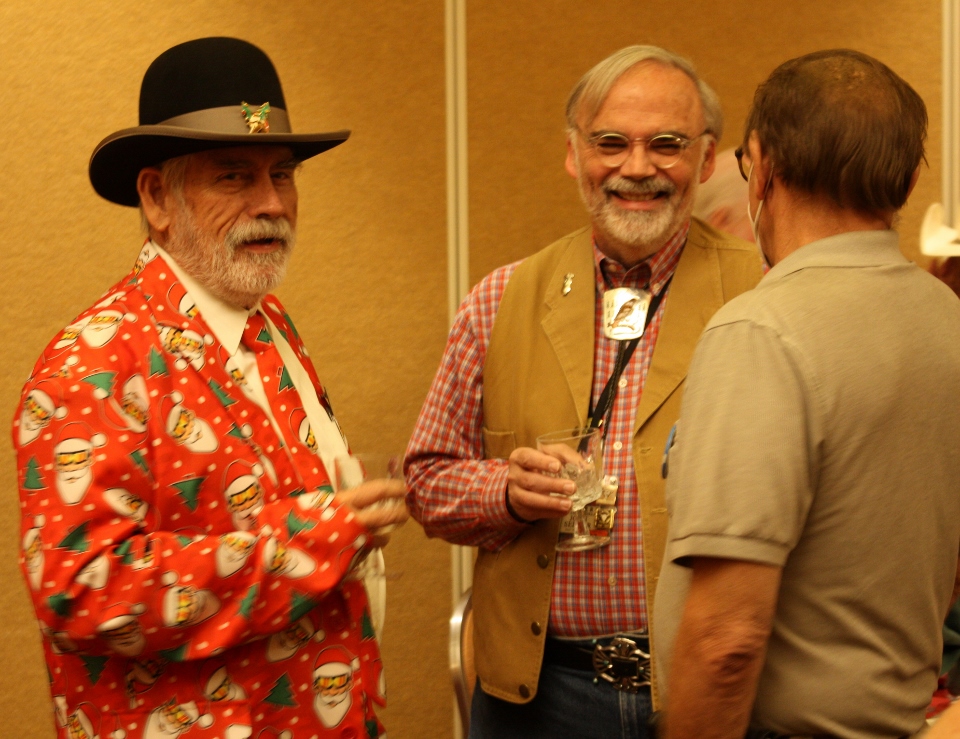
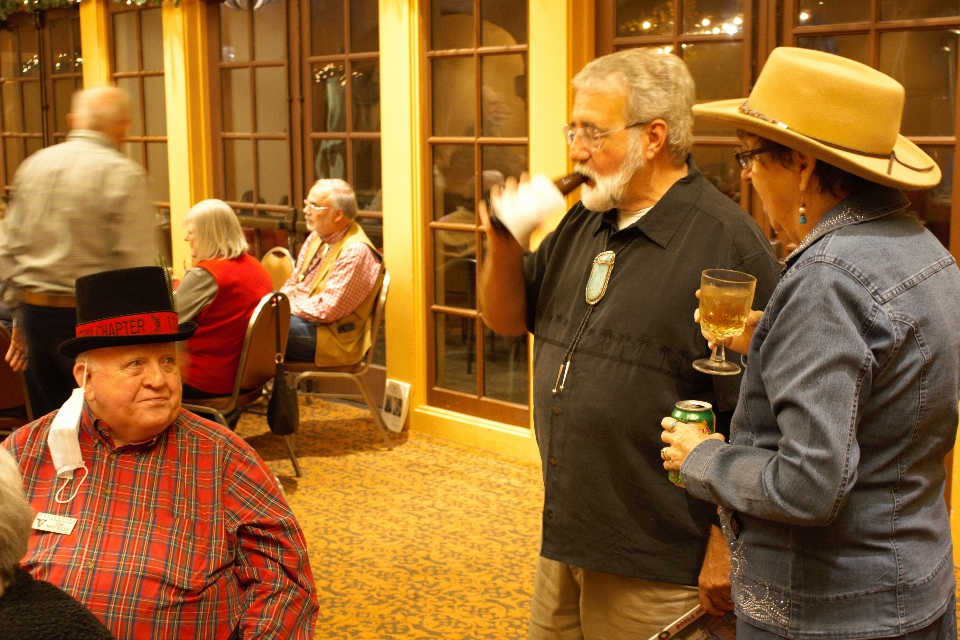
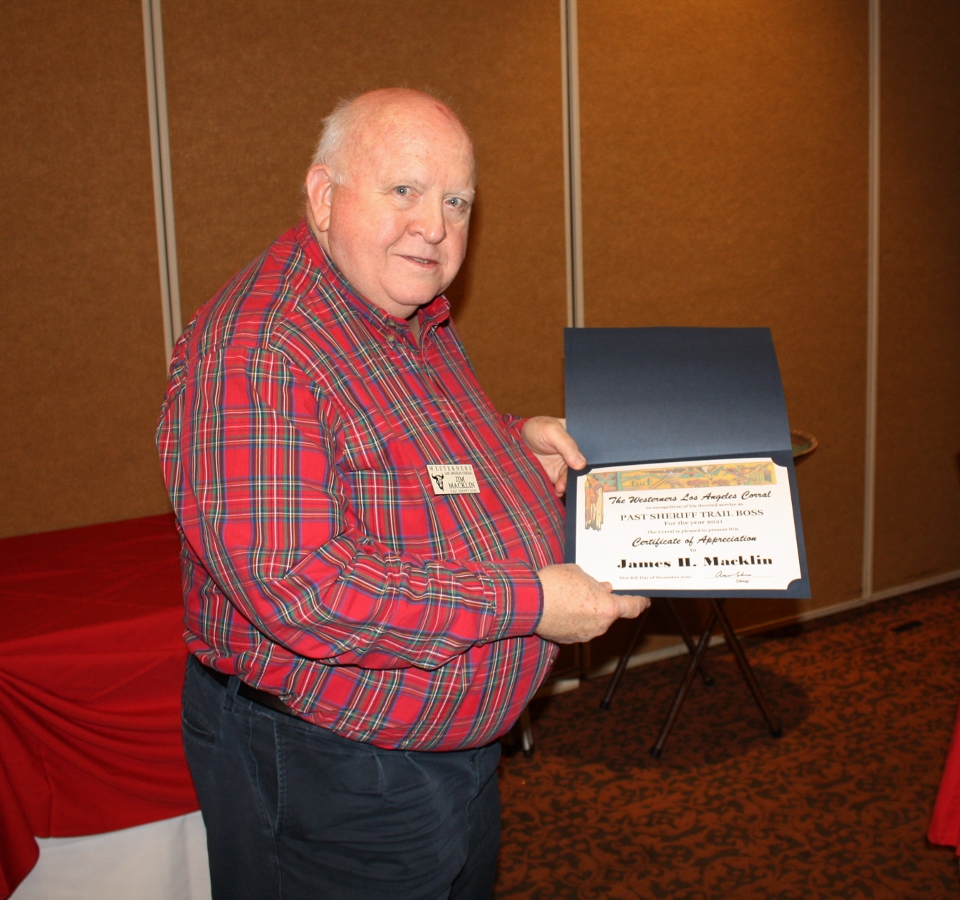
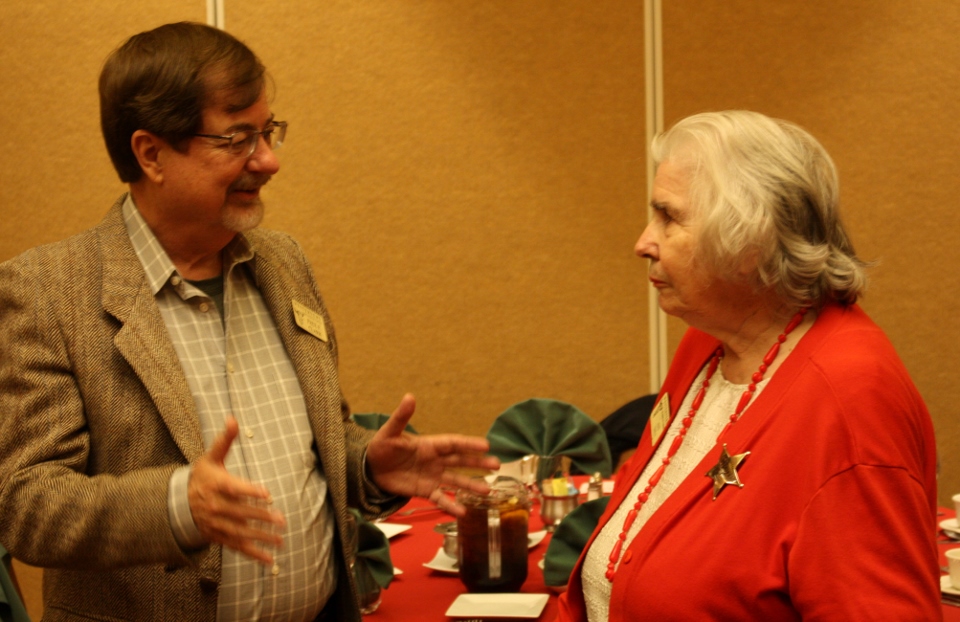
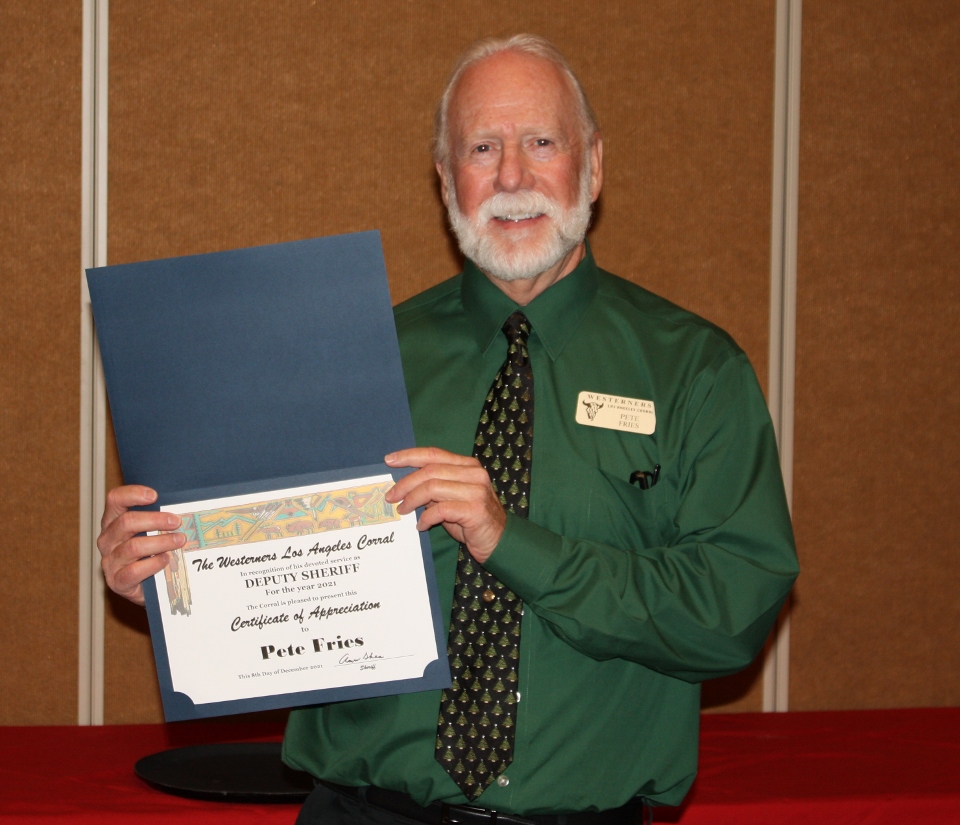
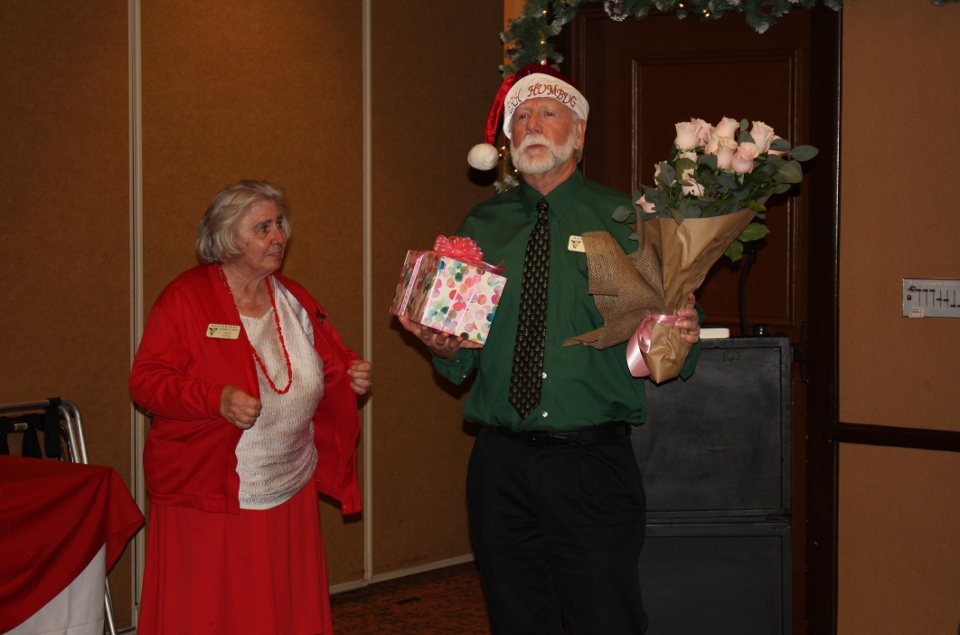
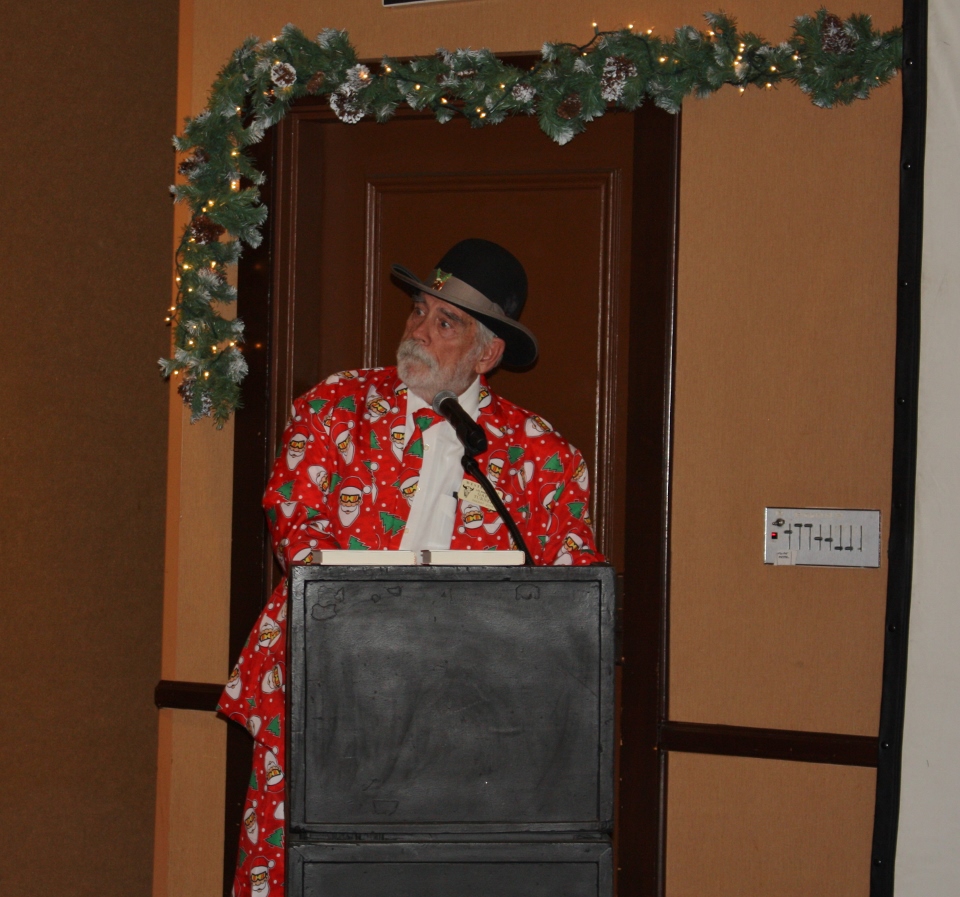
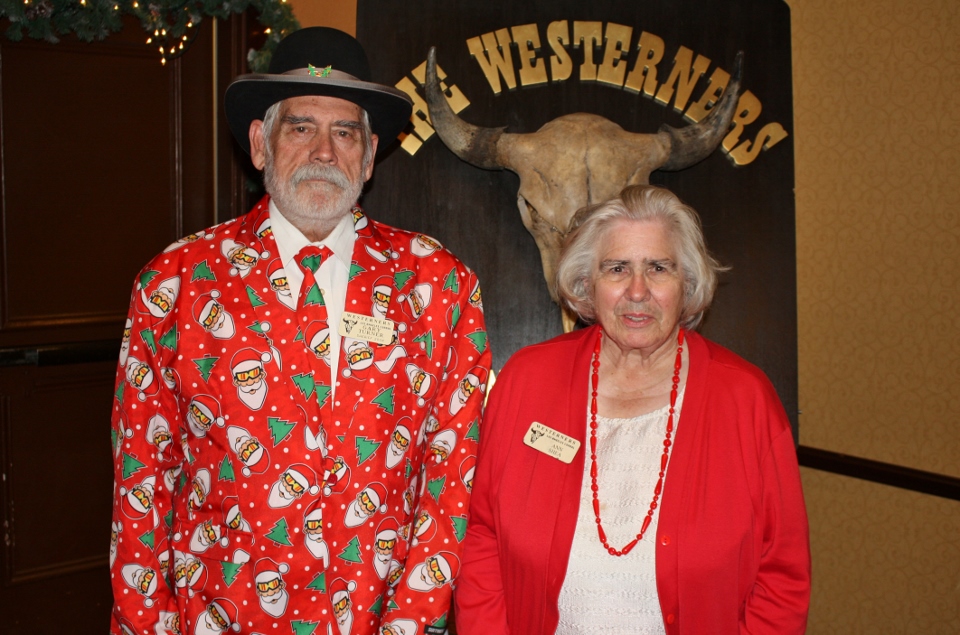
The December Roundup was the last meeting of 2021, and of the Westerners’ brief return to in-person gatherings before Omicron forced a new wave of pandemic restrictions. Blissfully ignorant of this future, our meeting was animated with festive cheer, cherries jubilee, and philosophical questions like, “Are we alone in the universe?” The night’s speaker, Gary Turner, offered his answer by sharing his personal journey down the rabbit hole—or rather, up the tractor beam—of UFOlogy. Since the dawn of prehistory, humanity has looked to the heavens as the realm of gods and fate, and devoted lifetimes to divining the wisdom in the stars. Pilgrims to Roswell, New Mexico, have retraced this ancient process of mythmaking, with extraterrestrials becoming today’s celestial beings. Scientific certainty has made the night sky cold and lonely by removing its sense of mystery, but with a little imagination, it can still, indeed, be out of this world.
— John Dillon
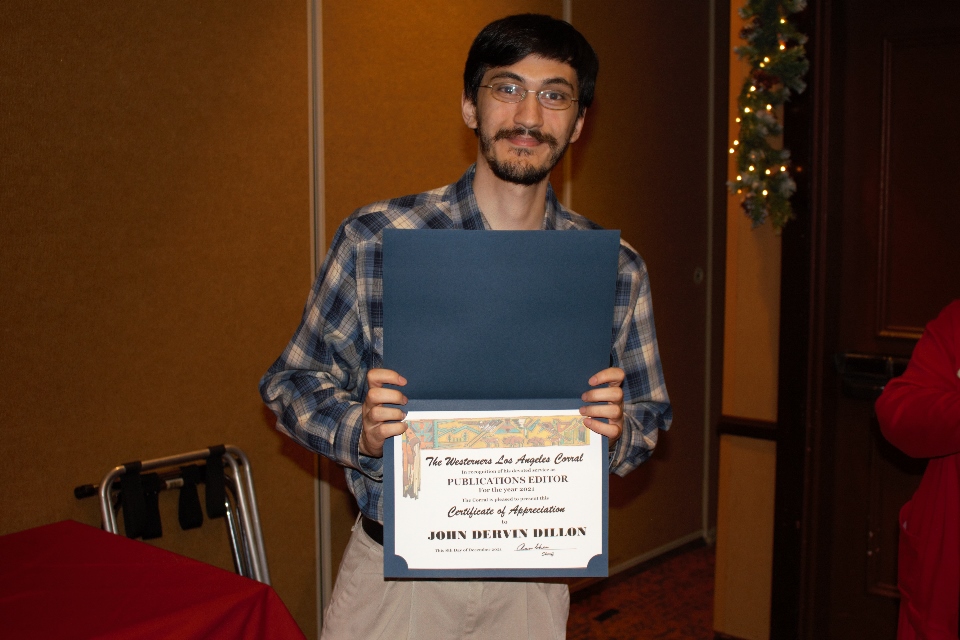
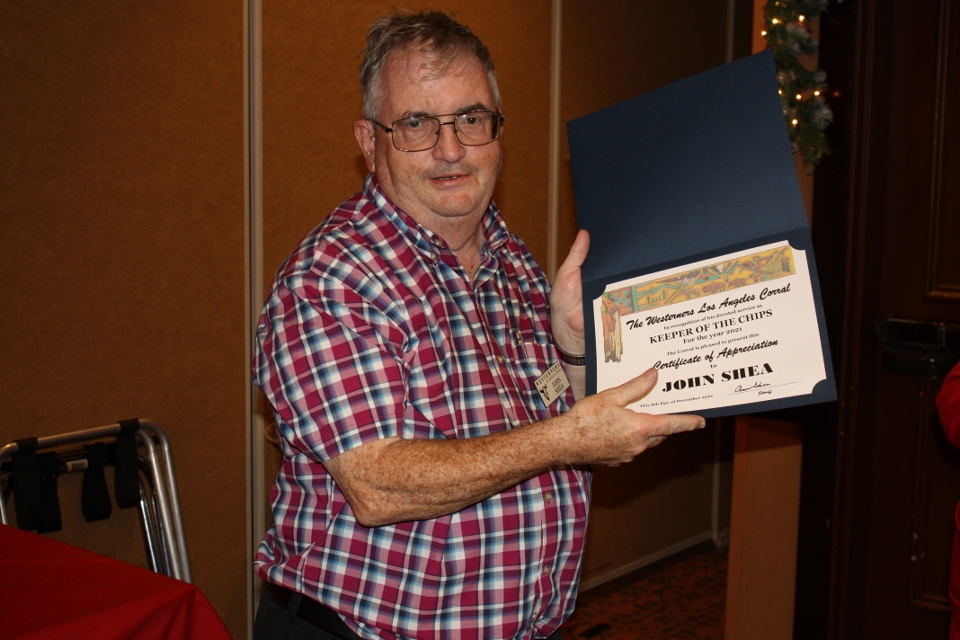
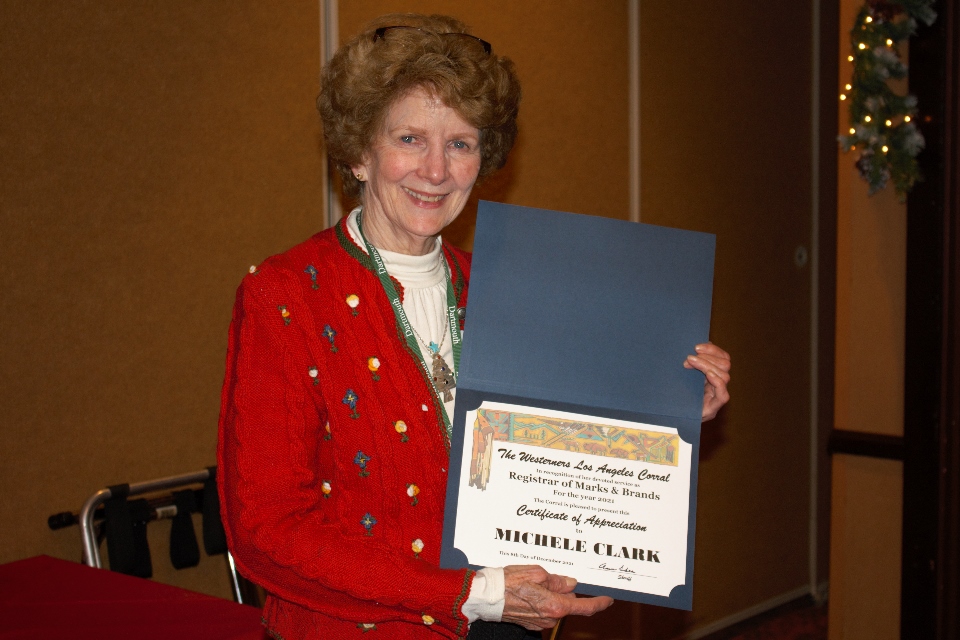
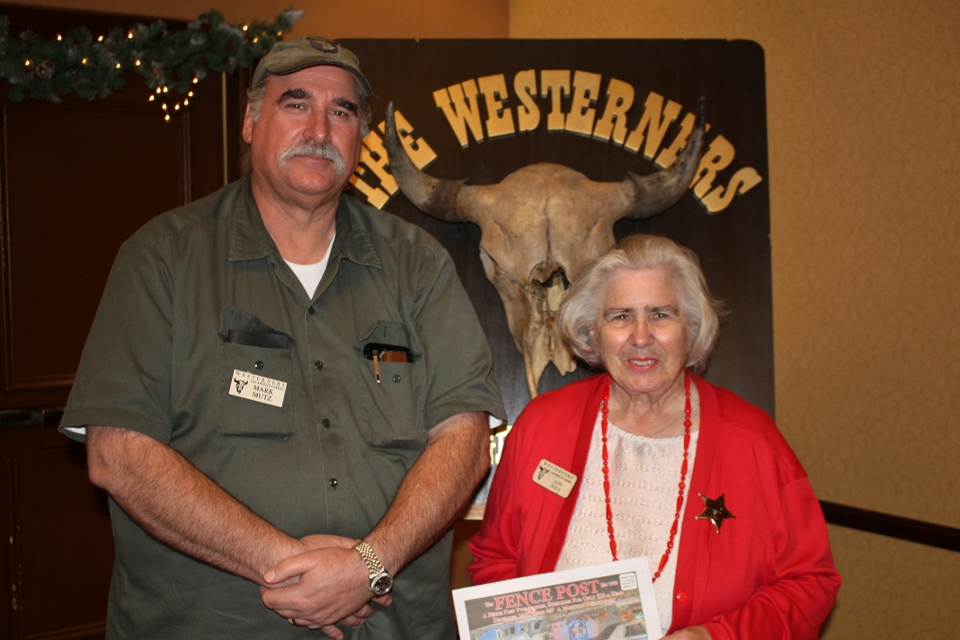
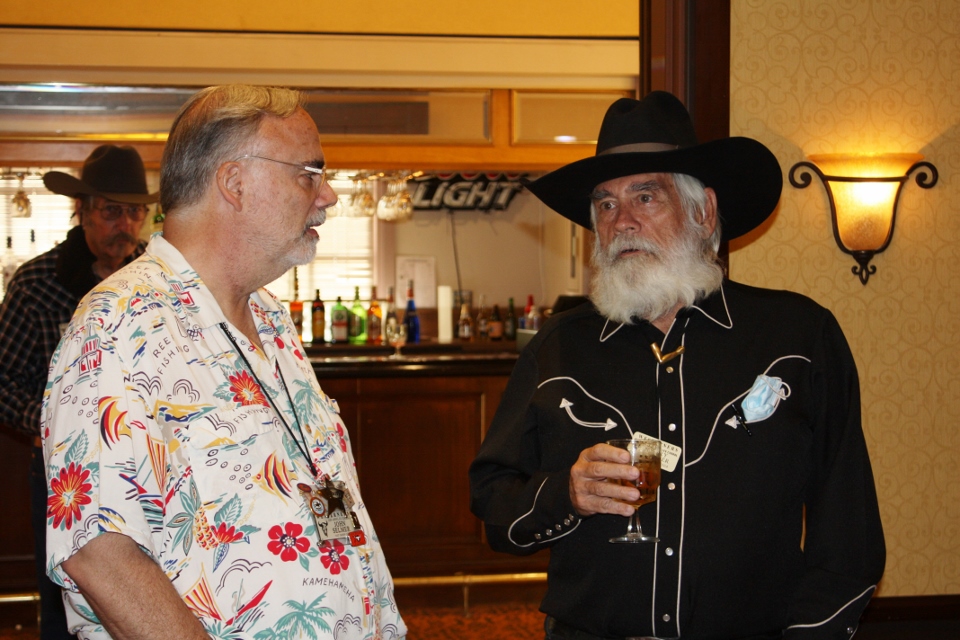
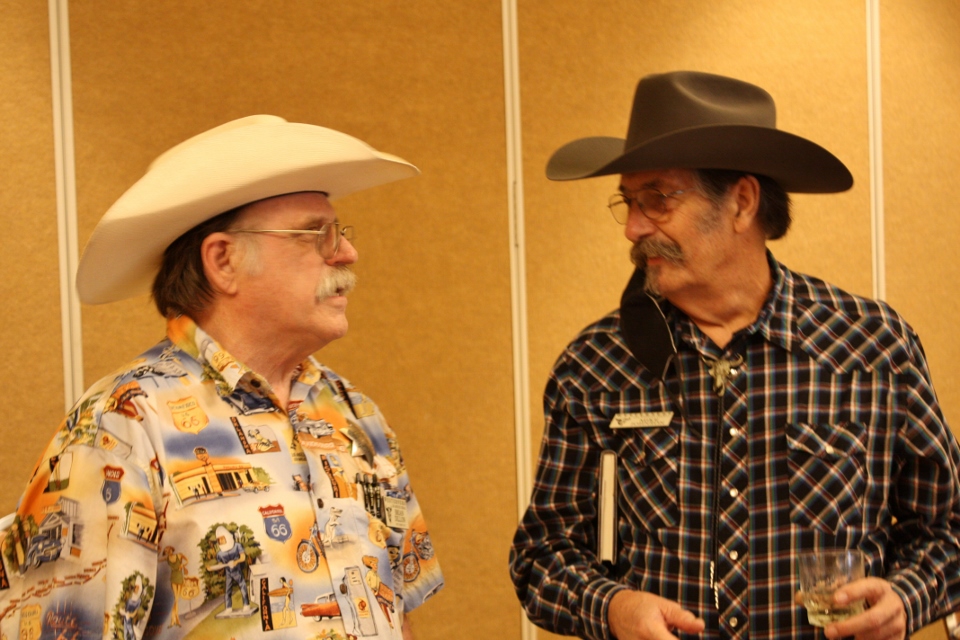
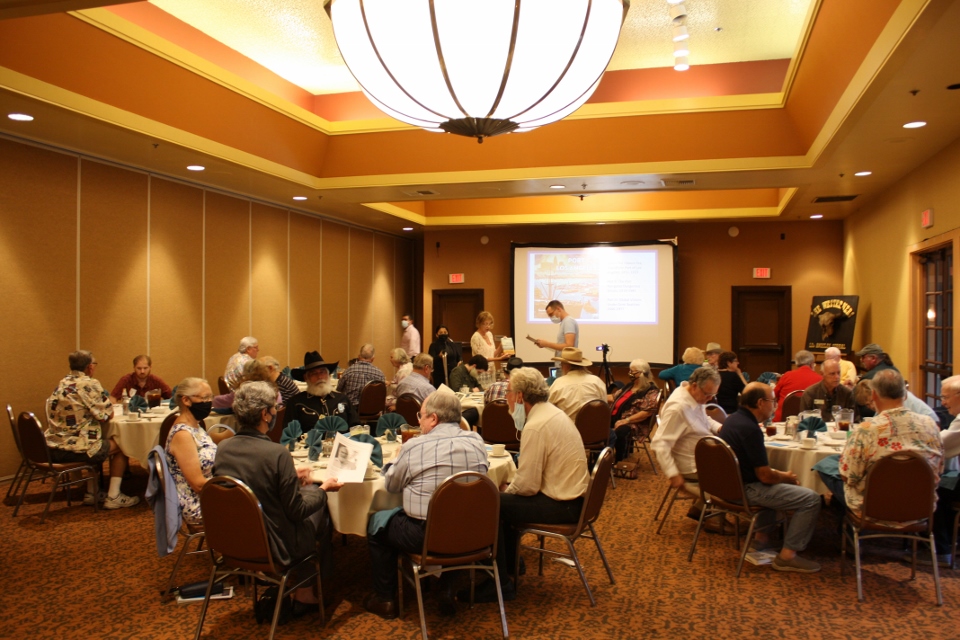
Photos from the Roundup
Roundup: November 2021
Roundup Synopsis
Taken from the Fall 2021 Branding Iron.
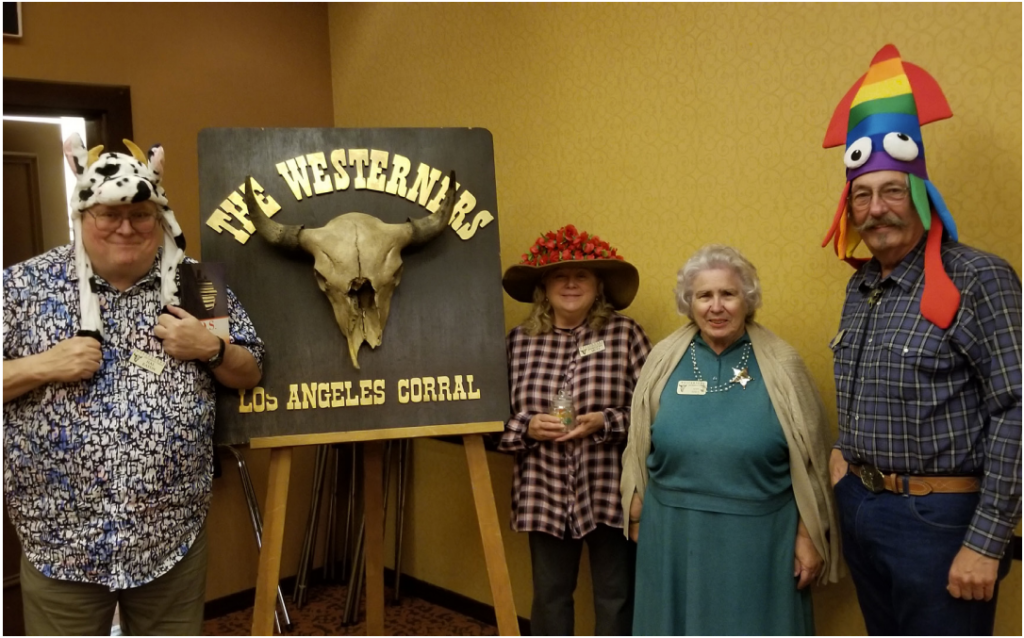
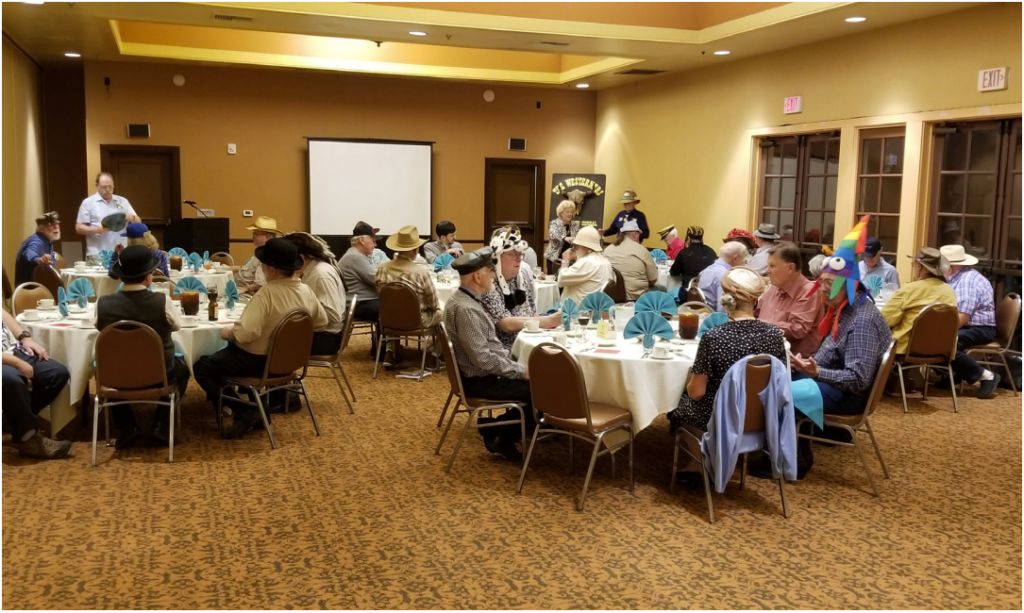
In November, we all traded our Stetsons for silly hats, as Crazy Hat Night descended upon Almansor Court. As usual, three standouts were chosen to take home prizes in honor of their daring fashion sensibilities. Mike Johnson had family to thank for his absurdly tall rainbow squid hat. Hal Eaton donned a bovine beauty, complete with twitching ears, and Dorothy Mutz looked lovely and over the top in her rose-covered cartwheel. Thanks to everyone who threw caution to the wind and sailed the silly seas. I would like to take this opportunity to buck for the next Crazy Shirt Night to come soon!
The evening’s presentation was given by a trilby-clad Mark Mutz (clearly, his better half had more hat mojo working that evening). Mr. Mutz took us on a journey through some of the area’s communities, exploring their beginnings as “irrigation colonies” created by Canadian-born developer George Chaffey.
George Chaffey was a man who understood that land without water wasn’t worth much. As such, when he sought to sell parcels of land in his first development, Etiwanda, the water rights were inexorably tied to the land. Each parcel could be sold and transferred as any other, but its right to water always went with it. This practice led to a far less murky and litigious environment than the one it succeeded. Its “water corporation” concept quickly became the standard system of distribution for water rights in California.
The success of the Etiwanda colony led Chaffey and Holt to purchase 6,216 more acres nearby, for what would become Ontario. This colony was founded with four guarantees: water rights for every land owner, a construction plan for beautiful Euclid avenue, a planned college of agriculture— which later became Chaffey High School, and a prohibition against alcohol. These tenets struck a resounding chord in line with the mores of the burgeoning progressive movement, and Ontario’s parcels sold well, marking another successful venture for Chaffey hot on the heels of his first.
Not all of Chaffey’s endeavours would meet with the same success as Etiwanda and Ontario, however. There was his failed bid to plot the Werribee River valley in Australia, scuttled by drought, a banking crisis, and Chaffey’s construction of a fancy home for himself while most investors were struggling to make use of their land. Manzanar, though not a fiscal failure, never thrived as a colony because it was purchased entirely by Los Angeles, and is now best known as the site of the infamous WWII Japanese internment camp. Another project truly did end in disaster, though not entirely due to Chaffey’s actions. That was his diversion of part of the Colorado River to irrigate the Imperial and Coachella Valleys and the Salton Sink. Heavy rain and runoff destroyed a relief canal, causing a flood that damaged large amounts of property, and led to not only a lawsuit by Southern Pacific, but to formation of the Salton Sea as we see it now.
In all, an entertaining evening that was kicked off by some hilarious headwear was capped by Mark’s fascinating portrait of one of our region’s less-well-known early developers. We were all reminded that one’s name needn’t have been Griffith, Doheny, or Huntington to have mattered to the creation of our humble little corner of the state. See you all on Crazy Shirt Night, whenever that may be.
— Alan Griffin
Photos from the Roundup
Roundup: September 2021
WHOOPI-TY-AYE-OH No. 2
BACK IN THE SADDLE AGAIN
September Roundup
Wednesday, September 8, 2021
Almansor Court – 700 S. Almansor, Alhambra, CA.
Social Hour: 5:00 PM
Dinner: 6:00 PM
Our Speaker: Dr. Geraldine Knatz
Her Subject: The Port of Los Angeles
In one of dozens of classic lines from Chinatown, John Huston’s Noah Cross says to Jack Nicholson’s Jake Gittes that Hollis Mulwray made this city, adding that he also made Cross rich in the process. Theirs was a freshwater empire, made of a complex recipe: greed mixed with altruism, adding hydrology, intrigue, and murder.
Geraldine Knatz insists that what we might call the Los Angeles saltwater story, the Los Angeles Harbor story, is every bit as compelling, mysterious, dramatic, important. She insists that the Port of Los Angeles deserves to have its own tales narrated. And she is right.
The Port of Los Angeles made this city. Its history explodes the intimacy of a case study. It is far more important than that. It very well might be the study of what made modern Los Angeles.
Personalities, crimes, power moves disguised as bureaucratic banalities, jurisdictional feuds, and outright warfare—it is all here. So, too, is the way that the port has remained umbilical to Los Angeles: feeding it, for sure, but also tethering it to worlds an ocean away.”
Roundup Synopsis
Taken From Branding Iron 304 Fall 2021.
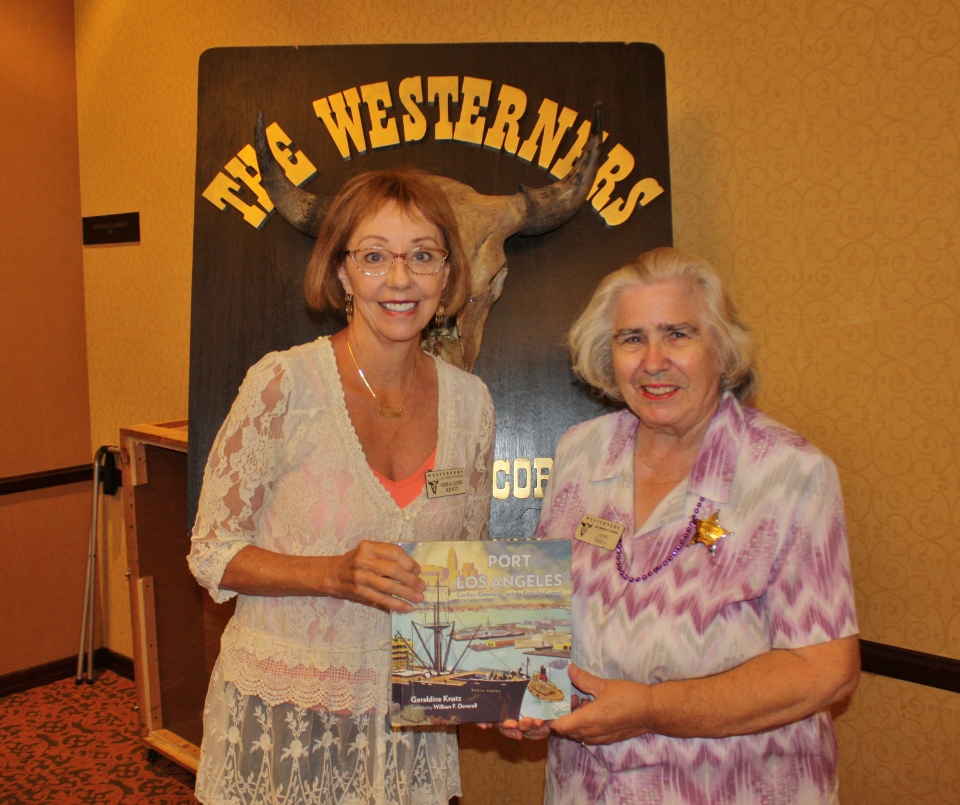
The guest speaker for the September Roundup was Geraldine Knatz, speaking about the early 20th-century history of the Port of Los Angeles, centered around her recent 2019 book, Port of Los Angeles: Conflict, Commerce, and the Fight for Control.
Thomas Gibbon in 1891 attempted to build a wharf on Rattlesnake Island (now Terminal island), on tidelands held by individuals erroneously sold by the state. His case was successful, but no action occurred until he was appointed to the Board of Harbor Commissioners in 1907, when he then pushed for the state to recover the property. An agreement was reached in 1917 for the property owners to turn the land over to the city in 30 years. This land would eventually become the Port of Los Angeles. Wilmington and San Pedro would eventually be consolidated with Los Angeles, with the tidelands being transferred to the city. Mormon Island, belonging to the Banning family, was also absorbed by the city in the 1930s after a long legal battle. Thomas Gibbon also attempted to have a railroad built, but this never saw the light of day.
In the 1920s Walter B. Allen was appointed to the Board of Harbor Commissioners, and was seen as someone who could clean up the corruption, though he had his own conflicts of interest in trucking port cargo with his own delivery company. Allen was tasked by the city mayor to merge the ports of Los Angeles and Long Beach. Politics, rate wars, duplicate facilities, and Los Angeles’ desire to control Long Beach’s oil money triggered many attempts to merge the two ports, but they remained separate. Allen was eventually removed due to bad publicity for his involvement with the Julian Petroleum scandal. Many years later Assemblyman Vincent Thomas would also attempt to merge the two ports and was similarly unsuccessful.
WWII forever changed the world’s appreciation of the port. Los Angeles proved that it could move more than just oil, and could be a general cargo port as well. Meanwhile the port customer base was shifting from locally based oil companies to international shipping companies. By the 1960s, trade through Los Angeles Harbor had grown faster than its terminal facilities, longshore workforce, and its own office space could handle. The 1960s for the harbor also saw exciting developments, as if ripped straight from the latest film noir: corruption, graft, secretly taped meetings, indictments, a suspicious death, and a Pulitzer Prize-winning exposé by the Los Angeles Times.
The Port of Long Beach would grow so rapidly that the Los Angeles Board of Harbor Commissioners voted to support merging of the two ports. We continue to hear past and present arguments supporting this initiative, but the ports of Los Angeles and Long Beach remain separate to this day
— Patrick Mulvey
Photos from the Roundup
Los Angeles Corral of Westerners
Welcome to the online home of the Los Angeles Corral of Westerners. We invite you to browse our site, learn more about our organization, and even consider joining us.