Living Legend No. 60 – Monsignor Fancis J. Weber
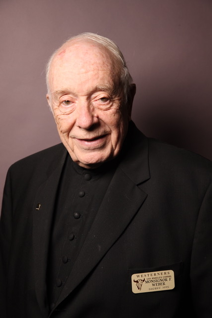
Westerners International Living Legend No. 60 Monsignor Francis J. Weber
Monsignor Francis J. Weber is one of the most active of all members of the Los Angeles Corral of Westerners. He was first persuaded to come to corral round-ups by the archaeologist and historian Mark Raymond Harrington in 1962, the same year he became the Archivist for the Catholic Archdiocese of Los Angeles. Weber became a member of the Los Angeles Corral in 1969, and presented his first invited lecture to it in 1970. His most recent of more than a dozen presentations came forty-six years later, in 2016. Monsignor Weber threw open the gates of San Fernando Mission to the Corral in 1973, for that year’s annual Fandango. He has contributed more than a dozen articles to the Branding Iron, the Los Angeles Corral Quarterly, and was the editor of the Los Angeles Corral Brand Book No. 21 (1999), an amazing collection of no fewer than 73 contributions by members, friends, and other local historians. Weber served as the Los Angeles Corral Sheriff in 1995, and his leadership is remembered fondly by all members, especially its female ones, for finally making the corral co-ed.
Francis J. Weber was educated at the Catholic University of America and is the recipient of the only Honorary Doctorate ever granted to a priest by Azusa Pacific University. He has taught at many different ecclesiastical and secular institutions, including Immaculate Heart College, Mount St. Mary’s College, and the University of Southern California. Monsignor Weber has always been devoted to local history, and has encouraged many others, Westerners and non-Westerners alike, to take the plunge and get involved in research, writing, and publication. Foremost amongst such success stories is that of fellow Los Angeles Corral members Ken and Carol Pauley, who, after twenty-five years of research, published their magnificent historical volume (2005) on the California Mission most closely associated with Msgr. Weber: San Fernando, Rey de España. Weber, if not the only member of Westerners International to also be a priest, is certainly the only monsignor.
Father Weber has for more than half a century effortlessly navigated through both sacred and secular waters, offering guidance, leadership, and good fellowship to his diverse flocks, be they fellow historians or parishoners. Monsignor Weber is known to his many friends and admirers as “the Old Country Priest.” He is Archivist Emeritus of the Archdiocese of Los Angeles, and by common accord the most knowledgeable living scholar of California’s ecclesiastical history. Ordained in 1959, since that time he has celebrated Mass at a great many California locations, including Santa Cruz Island, and has been a tireless and effective spiritual and intellectual leader at San Fernando Mission. Msgr. Weber, in addition to his many local duties, serves as an Honorary Chaplain to His Holiness Pope Francis. Few historians ever get to see a major research archive built to their own specifications, much less one with their own personal, built-in “research cave,” but for Francis J. Weber, this dream came true for him at Mission San Fernando, Rey de España, in 1980. He is still there at the Archival Center, thirty-six years later, accompanied by his faithful dog (Shelty No. 7) Wild Bill Cody, just slightly younger (in dog years) than the Monsignor himself.
Weber is widely published on Spanish Colonial history, ecclesiastical history, and the history of California and the West. His books include: The California Missions as Others Saw Them, 1786-1842 (1972), A Select Bibliography of California Catholic Literature, 1856-1974 (1974), The Life and Times of Fray Junípero Serra (1987), The Mission in the Valley: A Documentary History of San Fernando, Rey de España (1987), Century of Fulfillment: The Roman Catholic Church in Southern California 1840-1947 (1990), Prominent Visitors to the California Missions, 1746-1842 (1991), Memories of an Old Mission: San Fernando, Rey de España (1997), The Literary High Spots of Mission Hills, California (1998), Cathedral of Our Lady of the Angels (2004), The California Missions (2005), Catholic Heroes of Southern California (2007), Blessed Fray Junípero Serra: An Outstanding California Hero (2008) and More Memories of an Old Country Priest (2011), to name just a few. Monsignor Weber is such a prolific writer that his 30+ years of newspaper columns were updated and republished in the year 2000 in an 1148-page volume (Encyclopedia of California’s Catholic Heritage, 1769-1999), and the complete listing of his early publications, the 1995 hard-cover book A Bibliographical Gathering: The Writings of Msgr. Francis J, Weber, 1953-1993 extends to a whopping 270 pages. In order to accommodate the 23 years of publishing since, a second volume is obviously indicated. Weber’s present writing task is the third volume in his Memories of an Old Country Priest series.
The Los Angeles Corral of Westerners is proud to claim many outstanding members who have made their mark in educational, literary, and bibliographical contexts, above and beyond their service to our organization. Nevertheless, a very few illustrious members stand head and shoulders above the rest of us. Monsignor Francis J. Weber is just such a Westerner, and all members of the Los Angeles Corral congratulate him upon being honored, in the 70th year of our existence, as Westerners International Living Legend No. 60.
Brian Dervin Dillon, Ph.D.
Deputy Sheriff,
Los Angeles Corral of Westerners
December 15, 2016
Roundup: January 11, 2017
Almansor Court – 700 S. Almansor, Alhambra, CA.
Social Hour: 5:00 PM
Dinner: 6:00 PM
Our Speaker: Brian Dervin Dillon
His Subject: California, U.S.A. and the Mexican Revolution
The Mexican Revolution began in 1910, and lasted for more than a decade. It was the most cataclysmic and traumatic event of modern Mexican history, and the precursor of following revolutions in China (1911), Ireland (1916) and Russia (1917). America and Americans participated in every aspect of the Mexican Revolution, in all of its many different factions, yet this involvement, overshadowed by our participation in World War I immediately afterwards, is largely forgotten. The Revolution took place on both sides of the California border: it was born in places as surprising, yet familiar, as the University of California, Berkeley, and Los Angeles. The California end of the long international border was where the Revolution began, yet also where, through the efforts of enlightened men in both countries, it never went spinning out of control, as was later the case farther east.
Brian Dervin Dillon is a fifth-generation Californian. An archaeologist, he is both the son and the father of historians. A Phi Beta Kappa and Fulbright Fellow, at age 25 he was the youngest Ph.D. in his field since his UC Berkeley department’s founding. For more than forty years Brian has done archaeological, ethnographic and historical fieldwork in almost every California County, in all parts of Guatemala, and in three other Central American countries. Dr. Dillon publishes in three genres: archaeology, history, and firearms history. He has taught and lectured at UC Berkeley, UCLA, UCLA Extension, CSU Long Beach, The Southwest Museum and for the California State Department of Forestry. Brian is the recipient of more than two-dozen grants, fellowships and awards. He has traveled through every Mexican state for the past 50 years. Dr. Dillon’s two-part study on California and the Mexican Revolution was published in 2013, earning him one of the five consecutive Coke Wood Awards for historic writing from Westerners International he has been honored with.
Brian Dervin Dillon, Ph.D.
Deputy Sheriff
2015-2016 Event Photos
Taken by Patrick Mulvey, John Robinson Fellow
Patrick is a college student and his membership has been funded by Westerners. He has done a fabulous job taking photos of monthly meetings and events as well as other tasks. Westerners supports college students like Patrick and hope that others might apply to visit Westerners as well.
Please enjoy the photos below taken by Patrick. They are well done and really capture the spirit and appreciation of our Western heritage.
Galleries
2015 – Fandango & Monthly Meetings
Los Angeles Corral of Westerners
Welcome to the online home of the Los Angeles Corral of Westerners. We invite you to browse our site, learn more about our organization, and even consider joining us.